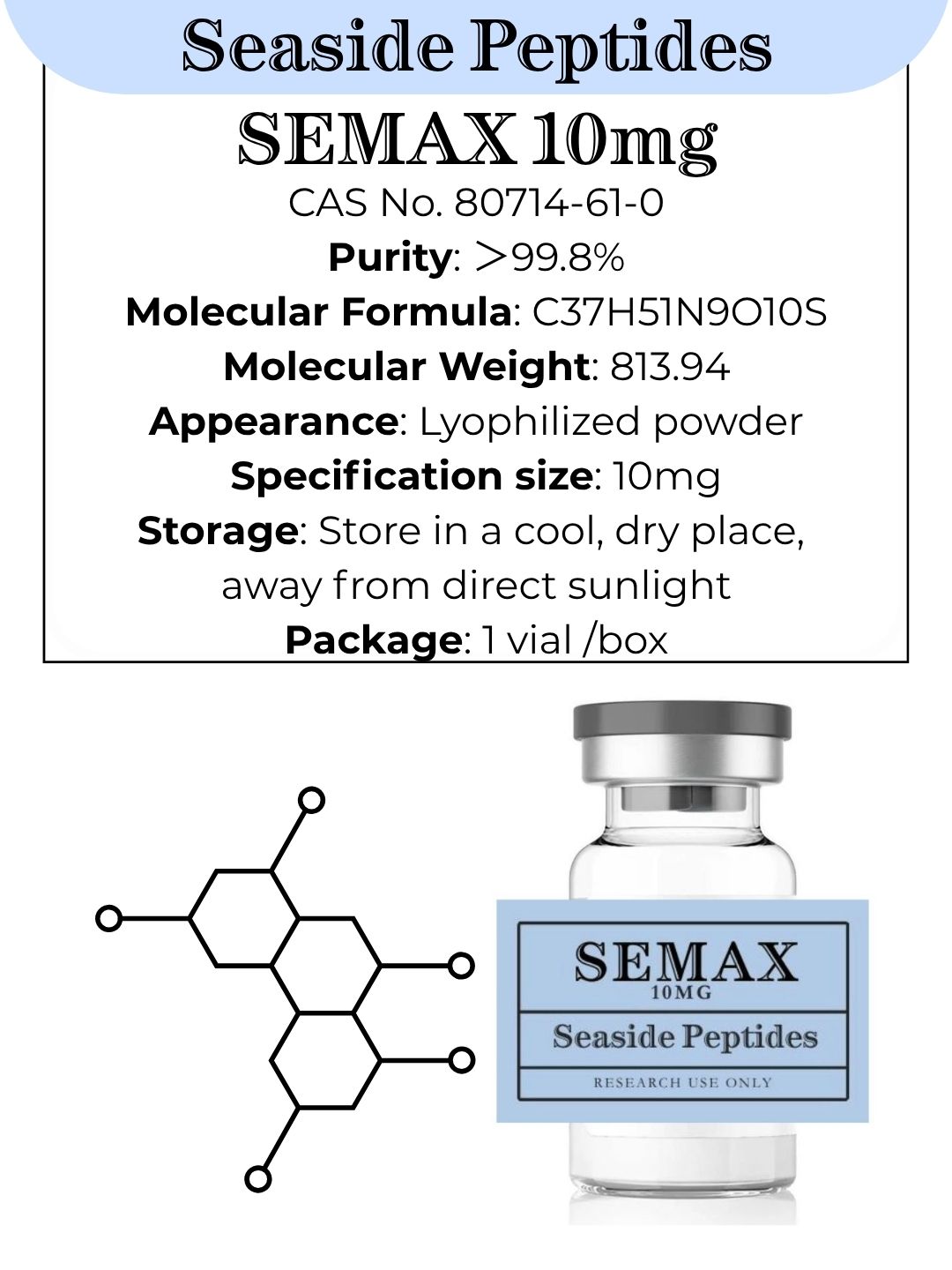
Description
Semax Research Peptide 10 mg RUO
Semax Peptide 10mg Research Only
Why is Semax studied? Based on one specific research study,(4) Semax may induce elevated secretion and release of dopamine as well as possibly increasing the levels of brain-derived neurotrophic factor (BDNF). Based on another study,(5) Semax has been speculated to also host the potential to alter gene expressions that modulate the immune system. In altering gene expression, the levels of immune cells and their mobility may be elevated. Semax was reported by researchers to exhibit altering potential in the encoding of chemokines and immunoglobulins, related to the functioning of the vascular system.
Research Use Only — not intended for diagnostic, therapeutic, or household use.
-
Brain — ischemia/stroke gene-programs
In rat focal cerebral ischemia, genome-wide analyses found Semax shifted immune, vascular, and neurotrophin-related gene expression, suggesting use as a tool compound in neuro-immune/vascular response research after injury. BioMed Central+1 -
Heart — post-myocardial infarction remodeling (preclinical)
Rodent studies examined Semax in MI models, reporting effects on cardiac sympathetic innervation remodeling and late ventricular changes after ischemia/reperfusion. PubMed+1 -
Biophysical neurodegeneration models — amyloid/metal interactions
In vitro work shows Semax can interfere with Aβ–Cu²⁺ complex formation and reduce amyloid aggregation in model systems, informing mechanistic studies of peptide–metal–protein interactions. PMC+1 -
Biochemical enzymology — enkephalin-degrading enzymes
Human-serum assays reported dose-dependent inhibition of enkephalin-degrading enzymes by Semax, a finding often used to motivate further research on neuropeptide tone and peptide stability. PubMed+2SpringerLink+2
Research Studies and Clinical Trials
Semax Peptide and Nootropic Action
An initial study(6) was conducted on ACTH hormone and its analogs, including Semax, to determine its nootropic potential in murine models. After peptide exposure in the models, 5-hydroxyindoleacetic acid (5-HIAA) levels were monitored. 5-HIAA levels appeared elevated by 25% after 2 hours of Semax presence. The levels appeared to increase gradually up to a maximum of 180% within 4 hours of peptide exposure. It was noted by researchers that the peptide, when introduced 20 minutes before D-amphetamine, appeared to lead to an elevation of 5-HIAA as compared to exposure to Semax alone. 5-HIAA is a primary metabolite of serotonin, which indicates that Semax might enhance serotonergic activity. This hypothetical influence on serotonin metabolism might enhance the functions of serotonin-dependent pathways, which may affect operations within the central nervous system. This speculative action underscores a possible modulation of neurotransmitter systems that play critical roles in mood, cognition, and overall brain function.
Semax Peptide and Neonatal Anxiety Models
The main aim of this study(7) was to expose neonatal murine models to an SSRI and then Semax, to evaluate the interaction. Murine models aged between 1 and 14 days received an SSRI, followed by Semax on days 15 to 28. After 28 days, it was noted that upon exposure to the SSRI, the rats exhibited anxiety-like behavior, with an apparently impaired response to stressors and new stimuli during the first 14 days. Following Semax exposure, these SSRI-induced actions appeared to be mitigated, with the rats even exhibiting improved learning abilities and an overall reduction in anxiety-driven behaviors. Researchers posited that Semax might have reestablished normal levels of monoamines in the brain, which may have been initially decreased by the SSRI. By affecting these neurotransmitter systems, Semax might restore or stabilize neural pathways that were previously disrupted. Such changes might balance the excitatory and inhibitory signals in the brain, creating a state more conducive to reduced anxiety. For instance, by potentially increasing serotonin levels, Semax may improve mood and decrease anxiety, while optimizing dopamine might enhance motivation and reward processing. Furthermore, norepinephrine adjustments might improve attention and vigilance. Behavioral assessments conducted in the experiment indicated that these potential actions of Semax appeared temporally stable. The reduction in anxiety-related behaviors was sustained from adolescence through young adulthood, suggesting that Semax might have a lasting influence on neural circuits. This enduring stability implies that Semax might support creating a protective or corrective action on these circuits that persists beyond immediate exposure.
Semax Peptide and the Vascular System
In this study,(8) researchers evaluated the potential of Semax to protect murine heart models from vascular damage after experimental myocardial infarction (MI). The murine models were induced with myocardial infarction, and a cohort of the models were exposed to Semax in an experimental group for the following 6 days. On the 28th day, it was reported by the researchers that the murine models that served as a control group appeared to have developed cardiac hypertrophy along with decreased arterial blood pressure. The Semax-exposed models exhibited signs indicating preventing diastolic pressure growth in the left ventricle, with apparent left ventricle remodeling. Notably, the peptide may have ameliorated both cardiomyocyte hypertrophy and the imbalance between the growth of contractile and mitochondrial apparatus.
- Shih-Jen Tsai, Semax, an analogue of adrenocorticotropin (4–10), is a potential agent for the treatment of attention-deficit hyperactivity disorder and Rett syndrome, Medical Hypotheses, Volume 68, Issue 5, 2007, Pages 1144-1146. https://doi.org/10.1016/j.mehy.2006.07.017
- Medvedeva, E.V., Dmitrieva, V.G., Povarova, O.V. et al. The peptide semax affects the expression of genes related to the immune and vascular systems in rat brain focal ischemia: genome-wide transcriptional analysis. BMC Genomics 15, 228 (2014). https://doi.org/10.1186/1471-2164-15-228
- Eremin KO, Kudrin VS, Saransaari P, Oja SS, Grivennikov IA, Myasoedov NF, Rayevsky KS. Semax, an ACTH(4-10) analogue with nootropic properties, activates dopaminergic and serotoninergic brain systems in rodents. Neurochem Res. 2005 Dec;30(12):1493-500. doi: 10.1007/s11064-005-8826-8. PMID: 16362768.
- Nataliya Yu. Glazova, Daria M. Manchenko, Maria A. Volodina, Svetlana A. Merchieva, Ludmila A. Andreeva, Vladimir S. Kudrin, Nikolai F. Myasoedov, Natalia G. Levitskaya, Semax, synthetic ACTH(4–10) analogue, attenuates behavioural and neurochemical alterations following early-life fluvoxamine exposure in white rats, Neuropeptides, Volume 86, 2021, 102114, ISSN 0143-4179. https://doi.org/10.1016/j.npep.2020.102114
Reviews
There are no reviews yet.