Description
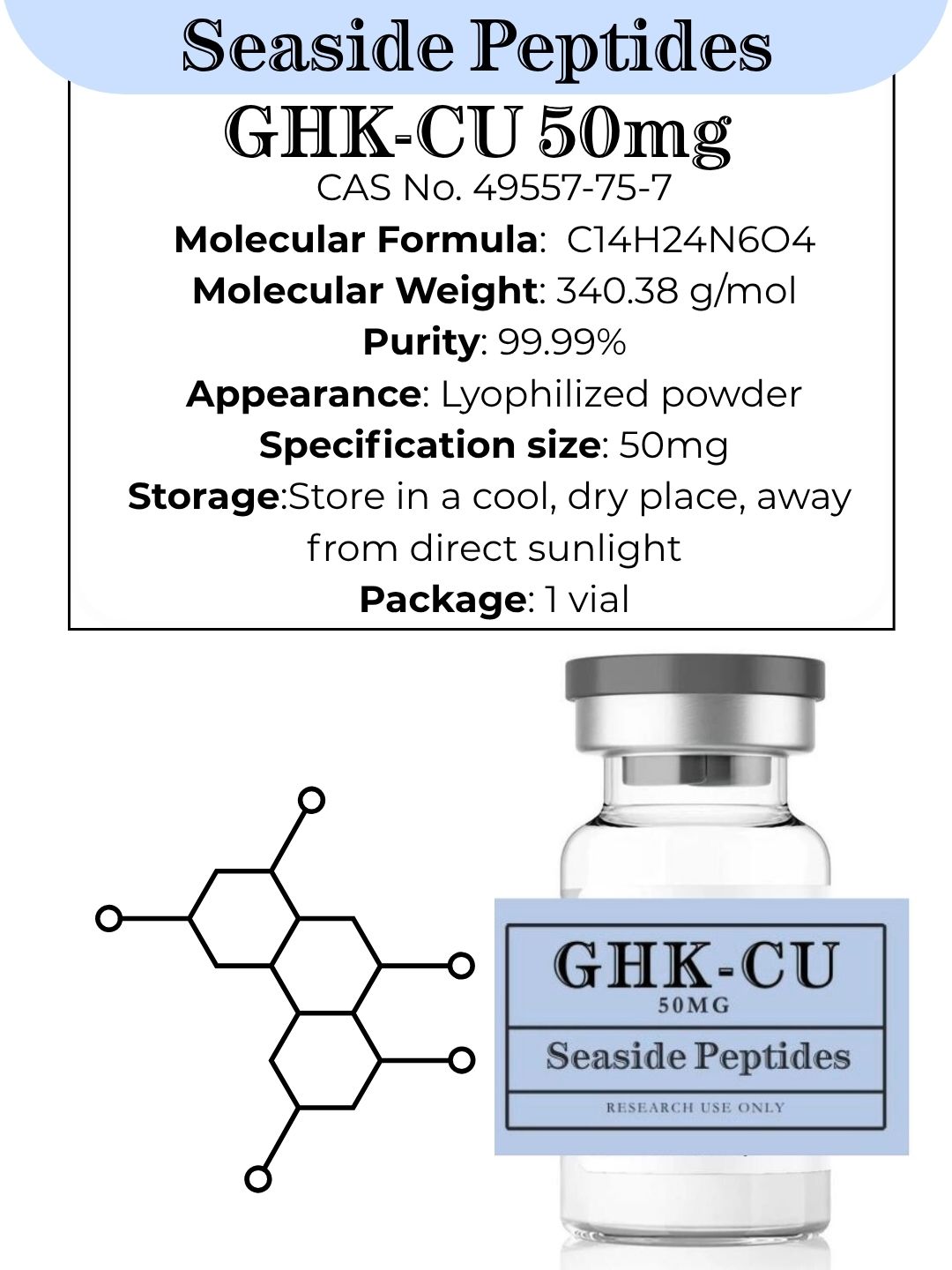
GHK-Cu Copper Peptide — 50 mg (RUO) · ≥99% HPLC Purity
GHK-CU 50mg Peptides Research RUO
GHK-Cu 50 mg — Lyophilized Research Peptide (RUO) · ≥99% HPLC Purity · LC–MS Identity Verified ·
GHK-Cu and Skin Cells
GHK-Cu is a natural component of blood and has been studied for its potential impact on dermal regeneration pathways. Research in skin cultures has suggested that GHK may stimulate the synthesis as well as the breaking down of collagen, glycosaminoglycans, and other components of the skin’s extracellular matrix like proteoglycans and chondroitin sulfate. This potential appears to be partially mediated through the positive action of GHK-Cu recruitment on fibroblasts, endothelial cells, and immune cells. The peptide appears to attract these cells to the wound site and coordinates their activity in repairing the damage. The peptide has also been researched for its potential modulation of collagen synthesis. Research in the roles of GHK-Cu suggests its actions may be mediated partially via an expression of transforming growth factor Beta. It is likely that the peptide works through various biochemical pathways and may modify gene expression. Studies in mice suggest that GHK-Cu may increase the rate of wound healing in burns by as much as 33%.[1] The peptide appears to recruit immune cells and fibroblasts to sites of injury and may promote the development of new blood vessels at these sites.
*In laboratory and preclinical settings, GHK-Cu is studied in assays related to extracellular matrix (ECM) markers, dermal/skin biology readouts, and angiogenesis/endothelial metrics. Typical endpoints include collagen-associated markers, barrier integrity, and cell viability in in-vitro designs. (No medical or human-use claims are made.)
GHK-Cu — Research Domains & Endpoints (RUO)
Tissue repair & ECM remodeling
-
Endpoints: collagen I/III expression, pro-collagen peptides, fibronectin, decorin, TGF-β pathway markers
-
Assays: fibroblast proliferation/migration, scratch/wound assays, tensile strength of ECM gels
Dermal biology & skin barrier models
-
Endpoints: filaggrin, involucrin, loricrin, ceramide profiles, TEER (barrier integrity)
-
Assays: keratinocyte–fibroblast co-cultures, 3D skin equivalents, barrier disruption/recovery models
Angiogenesis & endothelial function
-
Endpoints: tube formation, endothelial migration, VEGF/VEGFR expression, nitric oxide readouts
-
Assays: HUVEC/HMVEC angiogenesis plates, Matrigel tube assays, transwell migration
Matrix turnover (MMP/TIMP balance)
-
Endpoints: MMP-1/2/9, TIMP-1/2, elastase activity, glycosaminoglycan content
-
Assays: zymography, ELISA panels, gene/protein expression time-courses
Oxidative stress & copper homeostasis
-
Endpoints: SOD, CAT, GPx, GSH/GSSG, Nrf2 pathway markers, copper transporters (CTR1, ATP7A)
-
Assays: ROS challenge (H2O2/UV) with antioxidant rescue, ICP-MS or colorimetric copper quant
Inflammation marker exploration
-
Endpoints: IL-1β, IL-6, TNF-α, COX-2, NF-κB activity
-
Assays: cytokine panels (ELISA/chemiluminescent), NF-κB reporter lines, RT-qPCR arrays
Wound-healing model systems (in-vitro/preclinical)
-
Endpoints: re-epithelialization rate, granulation markers, angiogenic indices, collagen alignment
-
Assays: scratch closure, ex vivo skin, standardized preclinical cutaneous models
Hair-follicle & dermal papilla research (bench only)
-
Endpoints: dermal papilla ALK-phosphatase, Wnt/β-catenin markers, IGF-1, VEGF expression
-
Assays: follicle organ culture, DP cell proliferation/migration, gene expression panels
GHK-Cu and Lipid Peroxidation
A theoretical model posits that GHK could play a role in mitigating the discharge of iron from ferritin.(15) Ferritin, a protein complex that stores iron, releases it in a form that can facilitate lipid peroxidation, a process where free radicals attack lipids, leading to cell damage. It is suggested that GHK might inhibit the assembly of iron complexes within injured tissues, which could, in turn, decrease inflammation. Further exploration of GHK’s role reveals that it may interact with specific biological pathways that govern the release of iron from ferritin. This interaction might restrict the release of iron by up to 87%, although this is a provisional estimate. Such a significant reduction in iron release could conceivably diminish both inflammation and oxidative stress, the latter being a condition where damaging oxidative processes occur more rapidly than the body’s ability to counteract them, in the affected tissues.
GHK-Cu peptide is available for research and laboratory purposes only. Please review and adhere to our In laboratory and preclinical settings, GHK-Cu is studied in assays related to extracellular matrix (ECM) markers, dermal/skin biology readouts, and angiogenesis/endothelial metrics. Typical endpoints include collagen-associated markers, barrier integrity, and cell viability in in-vitro designs. (No medical or human-use claims are made.) before ordering.
Pickart L, Vasquez-Soltero JM, Margolina A. GHK and DNA: resetting the human genome to health. Biomed Res Int. 2014;2014:151479. doi: 10.1155/2014/151479. Epub 2014 Sep 11. PMID: 25302294; PMCID: PMC4180391. https://pubmed.ncbi.nlm.nih.gov/25302294/
Sakuma, S., Ishimura, M., Yuba, Y., Itoh, Y., & Fujimoto, Y. (2018). The peptide glycyl-ʟ-histidyl-ʟ-lysine is an endogenous antioxidant in living organisms, possibly by diminishing hydroxyl and peroxyl radicals. International journal of physiology, pathophysiology and pharmacology, 10(3), 132–138.
Zhang, Q., Yan, L., Lu, J., & Zhou, X. (2022). Glycyl-L-histidyl-L-lysine-Cu2+ attenuates cigarette smoke-induced pulmonary emphysema and inflammation by reducing oxidative stress pathway. Frontiers in molecular biosciences, 9, 925700. https://doi.org/10.3389/fmolb.2022.925700
-Miller, D. M., DeSilva, D., Pickart, L., & Aust, S. D. (1990). Effects of glycyl-histidyl-lysyl chelated Cu(II) on ferritin dependent lipid peroxidation. Advances in experimental medicine and biology, 264, 79–84. https://doi.org/10.1007/978-1-4684-5730-8_11
Savannah –
“Y’all ship quick. My CJC-1295 & Ipamorelin (RUO) arrived in two days, well-packed. Specs matched (≥99% HPLC, LC–MS identity). Customer service answered a couple questions right away—polite and helpful- a real person.”
Kelly –
Super clean presentation—lyophilized vials, sealed, and clearly marked RUO. Shipping was fast. Appreciate the documentation and the friendly customer service vibe. Easy five stars for logistics, Highly recommend.
Gina Shephard –
Fast delivery and as expected, thank you.