Description
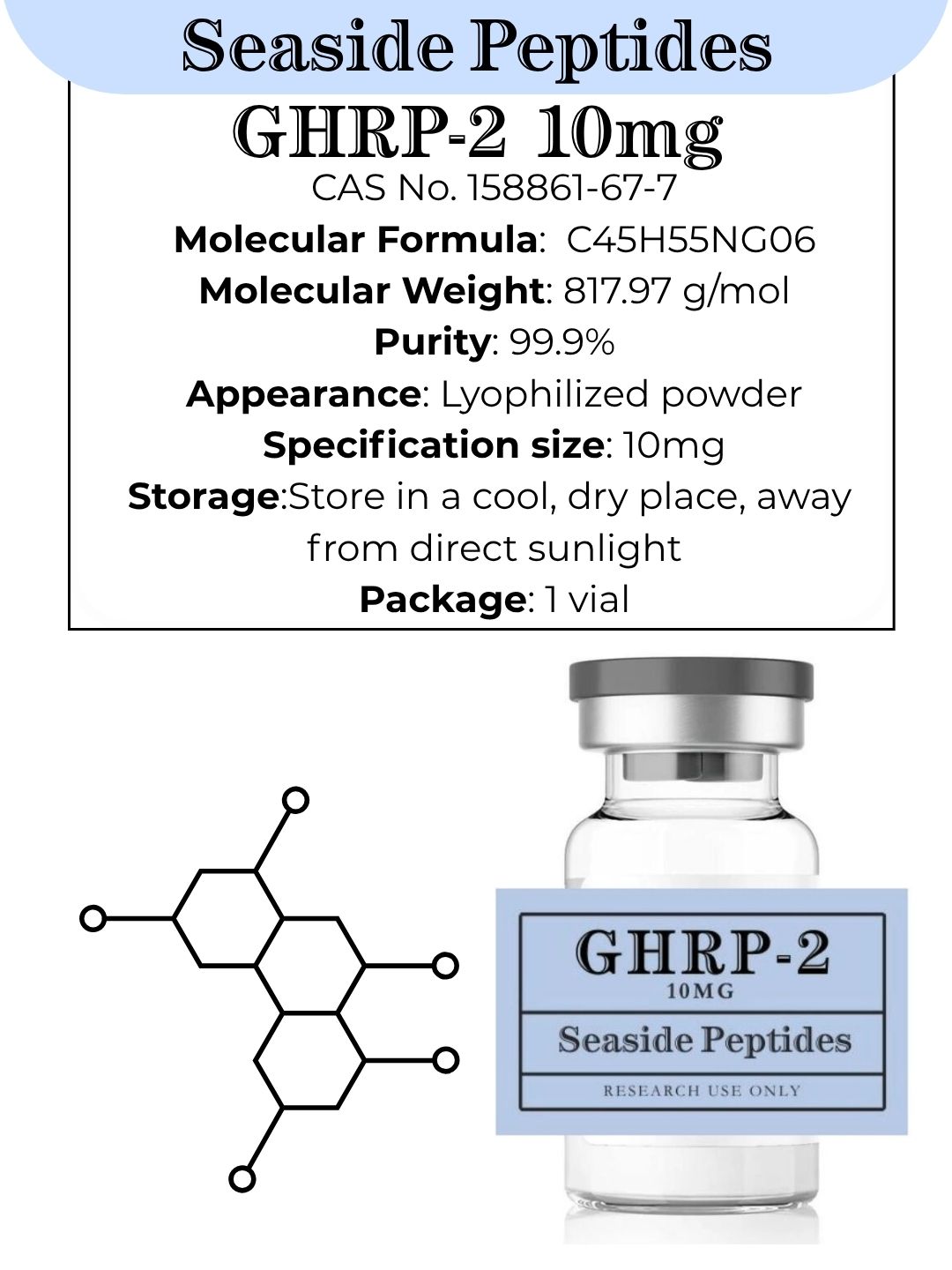
GHRP-2 10 mg — Lyophilized Research Peptide (RUO) · ≥99% HPLC Purity
GHRP-2 10 mg — Lyophilized Research Peptide (RUO) · ≥99% HPLC Purity
What is GHRP-2?
Growth Hormone Releasing Peptide-2 (GHRP-2) is a synthetic hexapeptide belonging to the family of growth hormone secretagogues (GHSs), compounds designed to stimulate the release of endogenous growth hormone (GH) from the anterior pituitary. Acting primarily through the ghrelin receptor, GHRP-2 enhances the natural pulsatile secretion of GH by amplifying hypothalamic signaling and reducing somatostatin’s inhibitory effects. This results in downstream increases in insulin-like growth factor-1 (IGF-1), a key mediator of growth and metabolic regulation. Compared with other GHRPs, GHRP-2 is recognized for its strong potency in elevating GH levels, with additional effects on appetite regulation, energy balance, and tissue repair. Because it stimulates endogenous GH production rather than providing exogenous hormone replacement, GHRP-2 is considered to offer a more physiological approach to augmenting growth hormone activity, and has been studied for potential applications in growth hormone deficiency, aging, metabolic dysfunction, and muscle-wasting conditions.
GHRP-2 & the GH axis
GHRP-2 interacts with growth hormone secretagogue receptors (GHS-R)—the same family engaged by ghrelin—found in the hypothalamus and pituitary. Binding is reported to trigger G-protein signaling (e.g., PLC → PIP2 cleavage → IP3/DAG), calcium release, and PKC activation, with downstream effects relevant to GH secretion in model systems.
Signal amplification & desensitization
Some studies describe complementary cAMP involvement that can amplify intracellular signaling in somatotroph models. Short-term receptor desensitization has also been noted after exposure, with sensitivity recovering a few hours later in experimental settings.
GH secretion & IGF-1 readouts
Across lab models, GHRP-2 has been associated with higher GH peaks and pulsatility versus GHRH alone, with reports of large fold-increases in GH output and corresponding rises in IGF-1. These findings are preclinical and context-dependent (assay type, dose, timing).
Skeletal muscle research
In animal/agri studies (e.g., yak models), GHRP-2 exposure has been linked to greater protein synthesis and reduced proteolysis, including lowered expression of atrogin-1 and MuRF1. Authors suggest an effect on muscle protein deposition pathways under stress conditions.
Cardiovascular & oxidative stress assays
Work in cardiac and vascular cell lines reports anti-apoptotic signals and modulation of oxidative stress markers. Proposed mechanisms include effects on CD36/OxLDL handling, reduced superoxide output, and changes in 12/15-lipoxygenase and inflammatory mediators in culture models.
Immune & nociception exploration
Preclinical literature includes investigations into thymic endpoints (T-cell–related measures) and pain pathways, where GHRP-2 is discussed as engaging specific opioid-receptor targets in animal models—separate from its GH-axis activity.
Sleep & appetite models
Experimental work has examined sleep architecture (e.g., slow-wave and REM proportions) and feeding behavior. In some models, researchers observed increased intake and GH AUC after GHRP-2 versus controls, consistent with ghrelin-pathway engagement.
Compliance
Research Use Only (RUO). Not for human or veterinary use. No dosing, administration, or medical claims are provided or implied.
Phung LT, Inoue H, Nou V, Lee HG, Vega RA, Matsunaga N, Hidaka S, Kuwayama H, Hidari H. The effects of growth hormone-releasing peptide-2 (GHRP-2) on the release of growth hormone and growth performance in swine. Domest Anim Endocrinol. 2000 Apr;18(3):279-91. doi: 10.1016/s0739-7240(00)00050-3. PMID: 10793268.
Sinha, D. K., Balasubramanian, A., Tatem, A. J., Rivera-Mirabal, J., Yu, J., Kovac, J., Pastuszak, A. W., & Lipshultz, L. I. (2020). Beyond the androgen receptor: the role of growth hormone secretagogues in the modern management of body composition in hypogonadal males. Translational andrology and urology, 9(Suppl 2), S149–S159. https://doi.org/10.21037/tau.2019.11.30
Veldhuis, J. D., Keenan, D. M., Bailey, J. N., Adeniji, A. M., Miles, J. M., & Bowers, C. Y. (2009). Novel relationships of age, visceral adiposity, insulin-like growth factor (IGF)-I and IGF binding protein concentrations to growth hormone (GH) releasing-hormone and GH releasing-peptide efficacies in men during experimental hypogonadal clamp. The Journal of clinical endocrinology and metabolism, 94(6), 2137–2143. https://doi.org/10.1210/jc.2009-0136
Bowers, C. Y., Granda, R., Mohan, S., Kuipers, J., Baylink, D., & Veldhuis, J. D. (2004). Sustained elevation of pulsatile growth hormone (GH) secretion and insulin-like growth factor I (IGF-I), IGF-binding protein-3 (IGFBP-3), and IGFBP-5 concentrations during 30-day continuous subcutaneous infusion of GH-releasing peptide-2 in older men and women. The Journal of clinical endocrinology and metabolism, 89(5), 2290–2300. https://doi.org/10.1210/jc.2003-031799
Reviews
There are no reviews yet.